

Michelle rolled her right shoulder before she had even sat down. At 36, the Hong Kong marketing manager was used to long days in front of a screen, but lately the stiffness had become harder to ignore. “It started as a stiff neck, and now it’s taking over my afternoons,” she explained.
Her day usually began with emails before breakfast, followed by video calls and lunch eaten over a report. Somewhere in the middle of it all, her right thumb would go numb on the mouse. She would shake it out and carry on. Around three o’clock, a headache often crept in at the back of her head. On the MTR home, she scrolled through messages with her chin tucked down. At night, one last look at her phone could turn into another forty minutes.
She had already tried the usual things. She stretched, bought an ergonomic pillow, took a painkiller after lunch, and promised herself she would spend less time on screens. None of it seemed to stick. “I figured it was stress,” she said. She was not wrong, but stress was only one part of the picture.
She is far from alone. A study of academic staff at a Hong Kong university found that 46.7% had neck pain over the course of a year, and 60.5% of those whose neck hurt at the computer held their head forward of their shoulders. So I treat it as a snapshot, not gospel. But it matches who walks into my chiropractic clinic every week.
So we sat down and went through it, one symptom at a time.
Is the screen causing the problem?
At The Chiropractic Centre, Michelle began by talking through her symptoms and what a typical day looked like. Her first question was simple: “So it’s my phone and my laptop?”
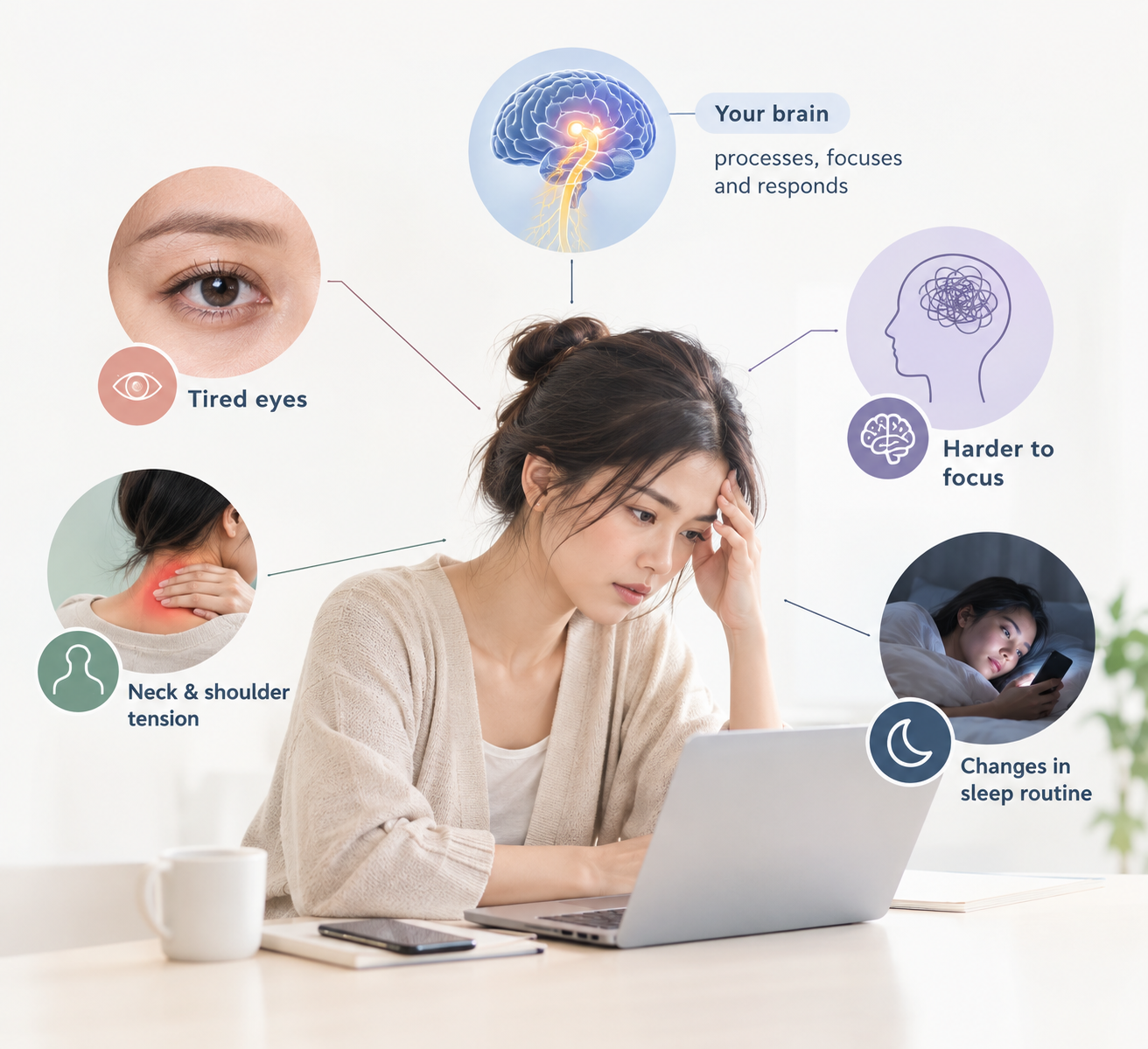
Partly, but not quite in the way people often think. The screen itself is not necessarily the villain. The trouble can be how still someone becomes while using it. Neck muscles support a head weighing roughly 4 to 5 kg, and muscles held in one position for hours can become uncomfortable, even when posture looks reasonably good. Long Screentime makes it easy to stay in the same position without noticing. For Michelle, changing position often was likely to be more useful than trying to hold a perfect posture all day.
Stress was another part of her routine. “Deadline weeks are the worst,” she said. “My shoulders live next to my ears.” Under pressure, the nervous system can increase tension in the neck and shoulders, and that tension may linger after a meeting has ended. The way the brain responds to stress can affect how tight those muscles feel. That is why Stress Management belongs in a conversation about neck pain, not just in a wellness brochure.
Her nights were not helping either. Screens are not generally considered to damage the brain, but scrolling in bed can cut into sleep. Too little sleep can affect Brain Function and leave someone with less energy to cope with stress the next day. For Michelle, late-night phone use, poor sleep, and daytime tension had become a cycle that was difficult to break.
The headache that starts in the neck
Michelle’s headache was another clue worth exploring. Pain that begins around the neck can often radiate toward the back of the head. While not every headache stems from the neck, understanding these connections is key to lasting relief.
She had also noticed tingling in her right thumb and first finger. Tingling can have different causes. For example, carpal tunnel syndrome involves a nerve at the wrist, while a nerve irritated in the neck may cause neck stiffness or soreness alongside pain, pins and needles, or altered sensation traveling down an arm. Symptoms can flare when the head turns or tilts, or when someone looks up. Which fingers are affected may offer clues, but cannot confirm the cause on its own.
Michelle was asked to keep a note for a week: which fingers tingled, when it happened and what seemed to change it. When she returned, the notes showed that her thumb and first finger tingled mostly at her desk, after long stretches with her head turned towards a second monitor, and rarely at night. That pattern made it sensible to consider both her neck and her wrist rather than assume the problem came from just one place. Keeping track of symptoms cannot replace an assessment, but it can help someone explain what is happening.
What a brain-based chiropractic visit looks like
At The Chiropractic Centre, the Brain Vitality Method combines brain and nervous system scanning, chiropractic adjustments, brain training and coaching. The coaching can include practical conversations about Stress Management and sleep habits.
Michelle’s first visit focused on understanding the wider picture. The discussion covered previous injuries, sleep, stress, and her workday. The team took posture photographs, conducted nervous system scans, and reviewed an X-ray report she already had. The approach considers how a person responds to physical, mental and emotional demands, then uses that information to help shape an individual plan.
A visit is an opportunity to discuss your symptoms, daily habits and goals, and to understand whether chiropractic care may be appropriate for your concerns. The team can explain what the assessment involves, how the findings may inform an individual plan, and what options are available. If your symptoms suggest a condition that needs medical evaluation, the team may recommend the appropriate next step.
Small Changes That Can Make Your Screen Habits Healthier
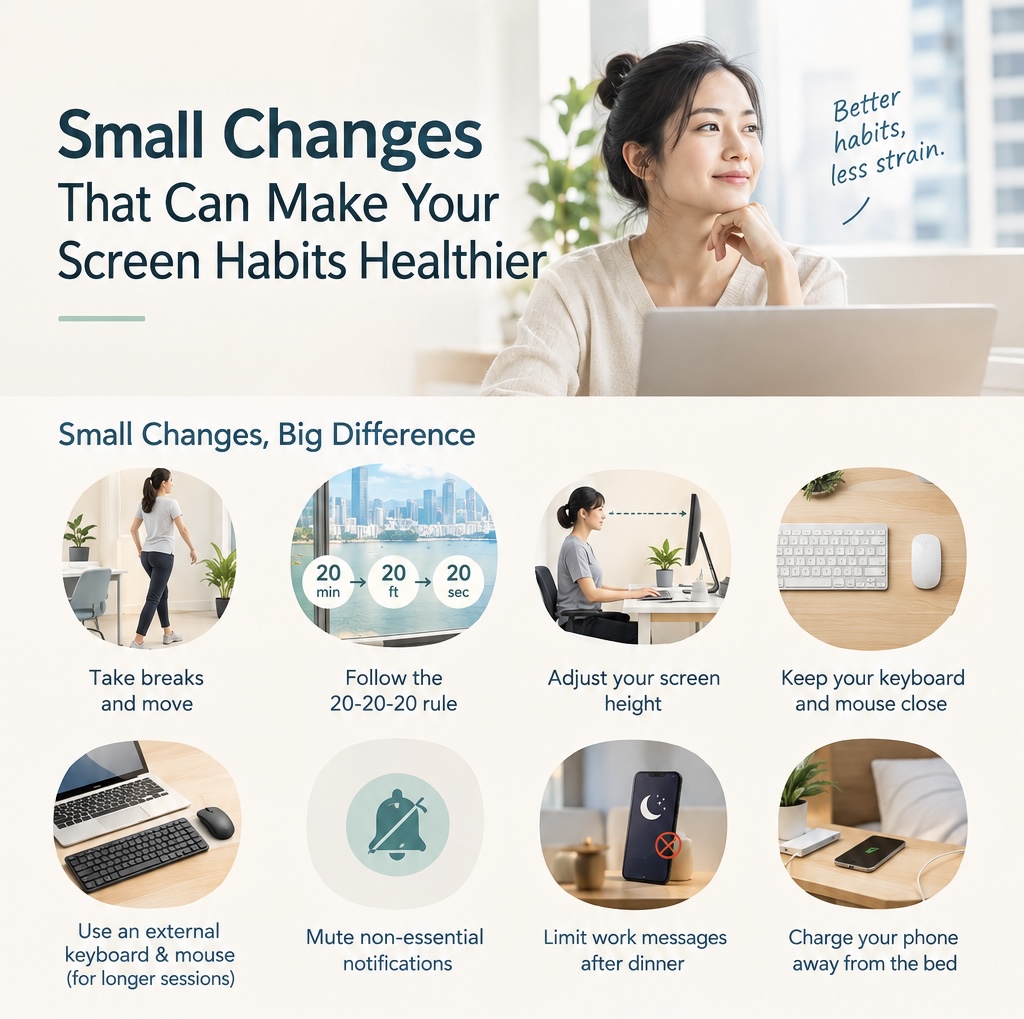
The changes that made sense for Michelle were small enough to fit into a normal working day. She raised her laptop so the top of the screen sat at eye level or just below, about half a metre away, and began using a separate keyboard and mouse. A headset stopped her from wedging the phone between her ear and shoulder during calls.
She started standing up and moving between meetings before checking messages. For eye comfort, she tried the 20-20-20 rule: every 20 minutes, she looked at something about 20 feet (6 metres) away for 20 seconds. On the MTR, she held her phone higher and switched hands from time to time.
The evenings took longer to change. Michelle muted non-urgent notifications while working, stopped answering work messages after dinner, and charged her phone outside the bedroom. That made it easier to reduce late-night screen time than relying on willpower alone. In everyday life, Stress Management can sometimes begin with creating a clear point at which work is allowed to stop.
When a stretch made her arm burn or tingle, she stopped rather than forcing through it. Pushing into symptoms can make nerve-related discomfort worse. The Chiropractic Centre has also discussed why stretching alone may not be enough in its article, “Neck Pain That Keeps Coming Back?”.
A Healthier Relationship With Technology Starts With Awareness
Michelle still spends much of her day in front of a screen, but she has become more aware of how her daily habits affect her comfort. She pays closer attention to her posture, notices when neck discomfort or headaches arise, and takes breaks instead of sitting for hours without moving.
Rather than changing everything at once, she focuses on small, realistic adjustments she can maintain.
“I stopped trying to fix everything at once,” she said. “I fixed the things I could keep doing.”
Michelle shows us that a healthier relationship with technology doesn’t mean giving up our devices. It means recognising our habits, listening to our bodies, and making small, consistent changes to how we use screens every day.
Reach Out to Our Team
If you are experiencing recurring neck or back discomfort, physical tension, or concerns about your brain and nervous system health, The Chiropractic Centre can explain the assessment and care options it offers.
Reach out to our team at The Chiropractic Center. We combine advanced nervous system scanning with gentle chiropractic adjustments, brain training, and simple lifestyle coaching to help you feel and function at your best.
If you’re curious about how your nervous system is handling the stresses of daily life, we’d love to start a conversation. Reach out to our team at The Chiropractic Centre on WhatsApp at +852 5664 8122 to explore your health history and book your Brain Vitality Assessment with Dr. Barry Decker to find the clarity you’ve been looking for.